A strategy to activate the gluteus medius, vastus medialis, and vastus lateralis in patients with knee injuries.
After a knee injury, one of the biggest challenges for the physiotherapist is not simply choosing exercises. The real challenge is knowing whether those exercises are actually activating the muscles that need to recover.
Many patients show a fairly typical pattern after a knee injury or surgery. Activation deficits appear in the gluteus medius and the quadriceps, strength decreases, and the knee loses part of its stability.
Even if the patient can walk or even train again, the neuromuscular system is not always prepared to tolerate complex loads or changes of direction.
This is where the most common clinical problem appears: exercises become progressively more demanding, but without knowing with certainty which muscle is actually doing the work. When the target muscle does not activate enough, the risk of recurrence or persistent pain increases.
In this context, an important question arises for rehabilitation: what type of load best activates the muscles that stabilize the knee?
The Study That Compared Stable and Unstable Loads
A study explored this question by using electromyography (EMG) to measure muscle activity during different functional exercises. The objective was to compare two very different types of load.

On one side, a stable load was used, represented by a sandbag. This type of resistance produces a constant and predictable stimulus, allowing the movement to be performed with greater control.
On the other side, an unstable load was used, in this case a water tank or water bag. The main characteristic of this type of load is that the weight shifts continuously during the exercise, forcing the neuromuscular system to make constant adjustments to maintain stability.
The study analyzed the muscle activity of three muscles that are especially important in knee rehabilitation:
- – Gluteus medius
- – Vastus medialis
- – Vastus lateralis
All of them play a key role in joint stability and dynamic control.
The Exercises Analyzed
To understand how these muscles behave under different loading conditions, the researchers evaluated several functional exercises commonly used in rehabilitation.
Muscle activation was measured during isometric single-leg stance, single-leg deadlift, forward lunge, and lateral lunge.
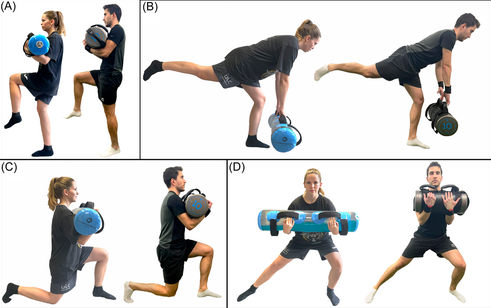
Each of these exercises was performed with both stable loads and unstable loads, allowing the researchers to compare how the neuromuscular system responded in each situation.
What Happened With the Gluteus Medius
The gluteus medius is one of the main stabilizers of the pelvis and the knee during single-leg support. When this muscle does not activate properly, compensations appear that may lead to knee collapse, instability, and overload in other structures.
The results of the study showed that the highest activation of the gluteus medius occurred when unstable loads were used.
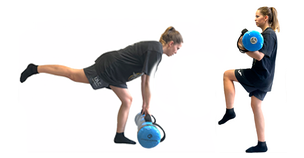
The exercises that produced the greatest muscle activity were the isometric single-leg stance and the single-leg deadlift when performed with the water-filled load.
This has a fairly clear biomechanical explanation. When the load is unstable, the body must continuously respond to small balance perturbations. This forces the neuromuscular system to increase the activation of stabilizing muscles, including the gluteus medius.
In other words, instability forces the nervous system to work harder to maintain postural control.
What Happened With the Vastus Lateralis
The vastus lateralis is part of the quadriceps and contributes not only to knee extension, but also to the lateral stabilization of the joint.
In this case, the exercise that produced the highest activation was the single-leg deadlift performed with an unstable load.
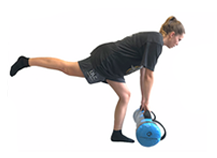
During this movement, balance control becomes particularly demanding. The body must simultaneously stabilize the hip, knee, and ankle while the load shifts.
The instability of the weight forces the muscles around the knee to respond continuously to prevent lateral deviations, which increases the activity of the vastus lateralis.
This reinforces an important concept in rehabilitation: when the goal is to improve dynamic stability, introducing a certain degree of instability can increase the participation of stabilizing muscles.
What Happened With the Vastus Medialis
The behavior of the vastus medialis was different. The exercise that produced the highest activation for this muscle was the lateral lunge performed with a stable load.
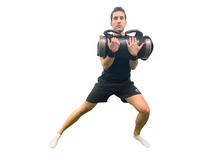
Unlike the other muscles analyzed, the vastus medialis responded better when the movement was performed in a more controlled environment.
The explanation relates to the primary function of this muscle. The vastus medialis contributes to knee extension and to controlling patellar alignment. To generate force efficiently, it requires a relatively stable environment that allows force to be applied with precision.
When the load becomes too unstable, part of the neuromuscular effort is directed toward maintaining balance, which may reduce the quadriceps’ ability to generate force.
For this reason, in this case stability promoted a more effective activation of the vastus medialis.
How This Post Helps You in Clinical Practice
One of the most common mistakes in rehabilitation is assuming that there is a single ideal type of exercise for every objective.
In reality, the type of load can completely change the muscular response.
Unstable loads tend to increase the activation of stabilizing muscles, because they force the neuromuscular system to constantly react to small perturbations.
Stable loads, on the other hand, usually allow greater force production and better technical control in muscles responsible for producing movement.
This means that the choice of load should always depend on the clinical objective.
If the goal is to improve stability and coordination, introducing instability can be a very useful strategy.
If the goal is to restore strength and control in the main movement pattern, a stable load may be more effective.
In many cases, physiotherapists select exercises based on clinical experience or general recommendations. However, muscle activation can vary significantly between patients and even between exercises that appear very similar.
Electromyography (EMG) allows you to observe which muscle activates, how strongly it activates, and how its behavior changes when variables such as load type, position, or technique are modified.
This transforms the way exercises are prescribed. Instead of assuming an exercise is effective, you can verify whether it is actually producing the neuromuscular response you are looking for.
Conclusion
The decision between using stable or unstable loads should not be random. Each type of load produces a different response in the neuromuscular system and may favor the activation of different muscles.
In patients with knee injuries, unstable loads can be especially useful for improving the activation of stabilizers such as the gluteus medius or the vastus lateralis.
Stable loads, on the other hand, may promote more efficient quadriceps activation when the goal is to restore strength and control in knee extension.
Understanding these differences allows you to design more precise rehabilitation programs adapted to the real needs of each patient.
And when you can measure how muscles respond to each exercise, you stop working based on intuition and start optimizing every clinical decision.
Now think about this: how many exercises are you using with unstable loads without really knowing whether they are activating the muscle you want?
Very often, instability is introduced with the idea that it will improve rehabilitation, when in reality it may be completely changing the muscle activation pattern.