Gluteus Medius vs Lumbar Muscles
Low back pain is one of the most common reasons for consultation in physiotherapy. Many patients arrive pointing directly to the lower back and describing stiffness, discomfort when walking, or pain that appears when they remain standing for long periods or perform everyday tasks.
In many cases, treatment focuses on the lumbar region: mobilizations, strengthening of the paravertebral muscles, or core training.
However, there is a muscular relationship that often goes unnoticed and that may explain a significant part of these symptoms. It is the synergy between the gluteus medius and the spinal erectors during single-leg support tasks.
When this relationship works correctly, the body can stabilize the pelvis and control movement without generating unnecessary overload in the lumbar spine. But when the gluteus medius fails to perform its function, the back ends up taking on a role that does not belong to it.
This is the silent synergy that is often overlooked. In this post, you will learn how it influences movement and how to assess it in your patients with low back pain.
The key relationship between the gluteus medius and the lumbar region
During activities such as walking, climbing stairs, or performing a single-leg squat, the body constantly enters phases of single-leg support. At that moment, pelvic stability depends largely on the gluteus medius’ ability to control the movement.
Under normal conditions, the expected pattern is clear: activation of the gluteus medius should be greater than that of the spinal erectors, both on the supporting side and on the contralateral side.

This allows the pelvis to remain stable while the trunk moves efficiently over the hip.
The gluteus medius acts as the main lateral stabilizer of the pelvis. Its role is to prevent the pelvis from collapsing toward the opposite side when the body is supported on one leg.
When this muscle performs its function correctly, the lumbar spine barely needs to intervene to maintain balance.
What happens when the gluteus medius does not control the support phase
The problem appears when the gluteus medius loses activation capacity or coordination.
At that moment, the body searches for an alternative strategy to maintain stability. One of the most common compensations is to increase the activity of the spinal erectors in order to prevent the trunk from shifting or losing balance.
This creates unilateral overload in the lumbar region. The spine begins to participate more than necessary in tasks that should mainly be resolved by the hip.
The result is often a pattern that is very recognizable in clinical practice. The patient describes persistent stiffness in the lower back, discomfort that appears when walking or shifting weight from one leg to the other, and pain that arises during functional activities such as climbing stairs, carrying loads, or standing for prolonged periods.
In many cases, the problem is not that the back is weak. The problem is that the hip is not stabilizing the movement correctly.
Why this synergy is so important in low back pain
Pelvic stability is one of the key factors for maintaining efficient lumbar mechanics.
When the pelvis moves in an unstable way during single-leg support, the lumbar spine is forced to compensate to maintain balance. This increases tension in the lumbar tissues and promotes the appearance of fatigue and overload.
Over time, this pattern can become a difficult cycle to break. The gluteus medius continues to participate little in movement, the lumbar region keeps compensating, and the pain reappears every time the patient performs everyday activities.
For this reason, evaluating this synergy can provide very valuable information. It allows you to determine whether low back pain is related to a hip stability problem rather than only a dysfunction in the spine itself.
How to identify this alteration in the clinic
Detecting this alteration is not always easy with simple observation. Many patients can perform movements correctly from a visual perspective, yet their muscle activation pattern remains inefficient.
An effective way to identify it is by analyzing muscle activity during functional tasks performed in single-leg support.
Movements such as weight-bearing hip abduction, single-leg squats, or exercises like the step-down allow you to observe how the gluteus medius and the spinal erectors behave when the body needs to stabilize the pelvis.
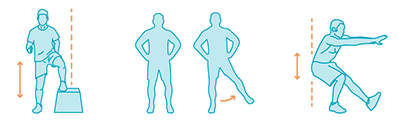
When a pattern appears in which the spinal erectors show greater activity than the gluteus medius, it confirms that stability is being generated from the spine instead of from the hip.
This type of compensation often goes unnoticed if the movement is analyzed only externally.
A typical example: the step-down
The step-down exercise is a very useful tool for observing this phenomenon.
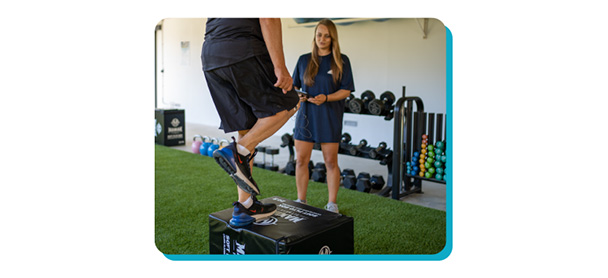
During this movement, the patient slowly descends from a step while supported on one leg. In theory, the gluteus medius should activate strongly to stabilize the pelvis while the body controls the descent.
When the synergy is correct, the movement is performed with good trunk control and the pelvis remains stable.
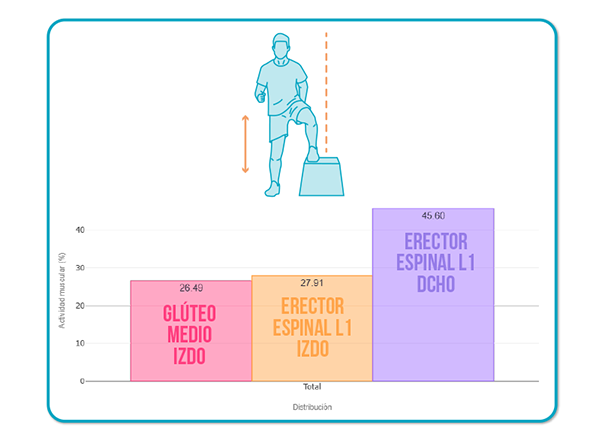
However, when the gluteus medius does not participate enough, the lumbar region begins to intervene more intensely. The spinal erectors become excessively active to compensate for the lack of lateral stability.
The result may be a movement that appears correct but gradually generates overload in the lumbar region.
Why many exercise programs fail to solve the problem
A very common situation in clinical practice is that a patient has been performing glute-strengthening exercises for weeks, yet low back pain continues to appear.
This happens because strengthening a muscle does not always mean that it will be used correctly during movement.
If the activation pattern does not change, the spinal erectors will continue to participate more than necessary. The patient may improve strength, but the synergy between the hip and the spine remains inefficient.
That is why some exercise programs fail to modify the underlying problem. The muscle may become stronger, but the nervous system continues to use the same compensatory strategy.
What happens when the synergy is retrained
When the gluteus medius resumes its primary function, the movement changes noticeably.
The pelvis stabilizes more efficiently and the trunk no longer needs to generate excessive tension to maintain balance. This reduces unilateral load on the lumbar region and allows the movement to become smoother.
Patients usually perceive this change quickly. The sensation of stiffness decreases, walking control improves, and functional tasks can be performed with less effort.
From a neuromuscular perspective, the system returns to the correct strategy: stability is generated from the hip rather than from the spine.
Conclusion
In many patients with low back pain, the problem is not located only in the back.
Sometimes the cause lies in an altered synergy between the gluteus medius and the spinal erectors during single-leg support.
When the gluteus medius does not stabilize the pelvis correctly, the lumbar spine compensates. This generates unilateral overload, persistent stiffness, and pain that appears during functional tasks such as walking or shifting weight from one leg to the other.
Identifying and correcting this muscular relationship can make a major difference in the patient’s recovery.
Because in many cases, low back pain is not resolved by strengthening the back, but by restoring the hip’s control of movement.