Are you repeating the same hamstring exercises with your patients without knowing whether they replicate the real activation demands of sprinting?
If so, your patient is probably still at risk of reinjury even after completing the recovery protocol.
Hamstring injuries are among the most common in sprint sports, have high reinjury rates and in many cases the muscle does not recover fully. The problem is not always the exercise chosen. It lies in not knowing whether that exercise reproduces the real muscular demand of sprinting or which muscles it is leaving untrained.
In this article you will discover what happens with biceps femoris, semitendinosus, gluteus maximus and spinal erector activation in four common rehabilitation exercises compared to sprinting, what clinical differences the EMG data show and how to use that information to design return-to-sport programmes that reduce reinjury risk.
What the gluteus maximus-hamstring synergy is in sprinting
During a sprint, the gluteus maximus, the hamstrings and the spinal erector do not work independently. They work in synergy: they activate in a coordinated manner to control hip extension, decelerate the lower limb in the late swing phase and absorb impact at ground contact.
When that synergy fails, one muscle takes on more load than it can handle. And in the case of the hamstrings, that usually ends in injury.
Rehabilitating the hamstrings without retraining that synergy is one of the most common errors in return-to-sport rehabilitation. And it is one of the main reasons why reinjury rates in hamstring injuries remain so high.
The mistake 95% of clinicians make
Repeating the same hamstring exercises over and over without verifying what they actually activate has three direct consequences:
You do not replicate the real activation of sprinting. The hamstrings work very differently in a controlled exercise than during the late swing phase of a sprint. If the exercises in your programme do not approach that demand in the advanced phases, the muscle reaches sprint unprepared.
You leave the gluteus maximus out. Hamstring injury in sprinting does not occur in the hamstring alone. It occurs in a context where the gluteus maximus, the spinal erector and the hamstrings work in synergy. If your programme does not include that synergy, you are rehabilitating the muscle in isolation and returning the athlete to a situation where the context remains one of risk.
Your patient remains at risk of reinjury. The high reinjury rate in hamstring injuries has a neuromuscular explanation: the muscle may have recovered maximum strength but not the activation pattern it needs during sprinting.
The study: four exercises compared to sprinting
In a study conducted with mDurance, EMG was used to measure the muscle activity of the biceps femoris, semitendinosus, spinal erector and gluteus maximus during four common hamstring rehabilitation exercises. The results were compared with the activation levels of those same muscles during sprinting.
The findings show clinically relevant differences between exercises, and most importantly: no single exercise exactly replicates the sprint pattern. This is why exercise selection according to the phase of the process is decisive.
The four exercises analysed
Exercise 1: Nordic curl
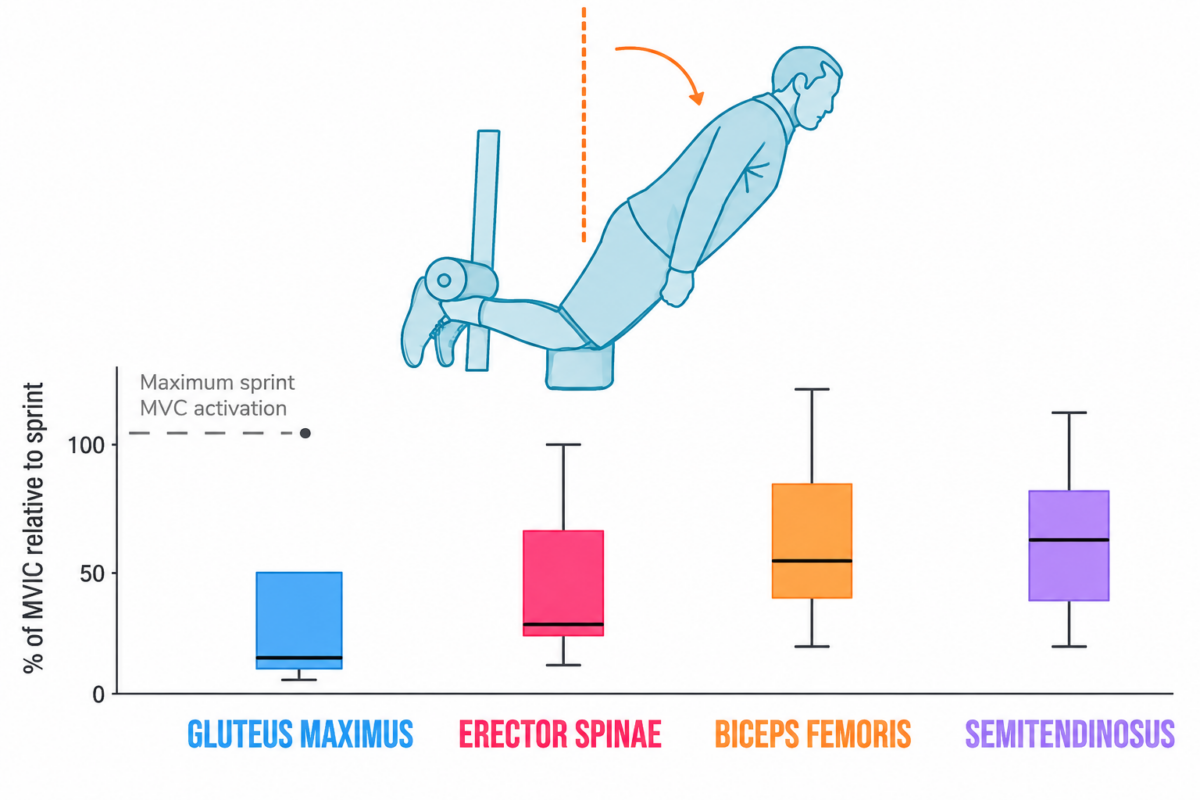
The Nordic curl generates high activation of the biceps femoris and the semitendinosus. It is one of the most evidence-backed exercises for hamstring injury prevention and rehabilitation.
However, the gluteus maximus has little involvement in this exercise. This makes it a useful tool for developing eccentric hamstring strength, but insufficient when used in isolation without adding exercises that integrate the gluteus maximus into the pattern.
Exercise 2: Russian belt (Russian hamstring curl)
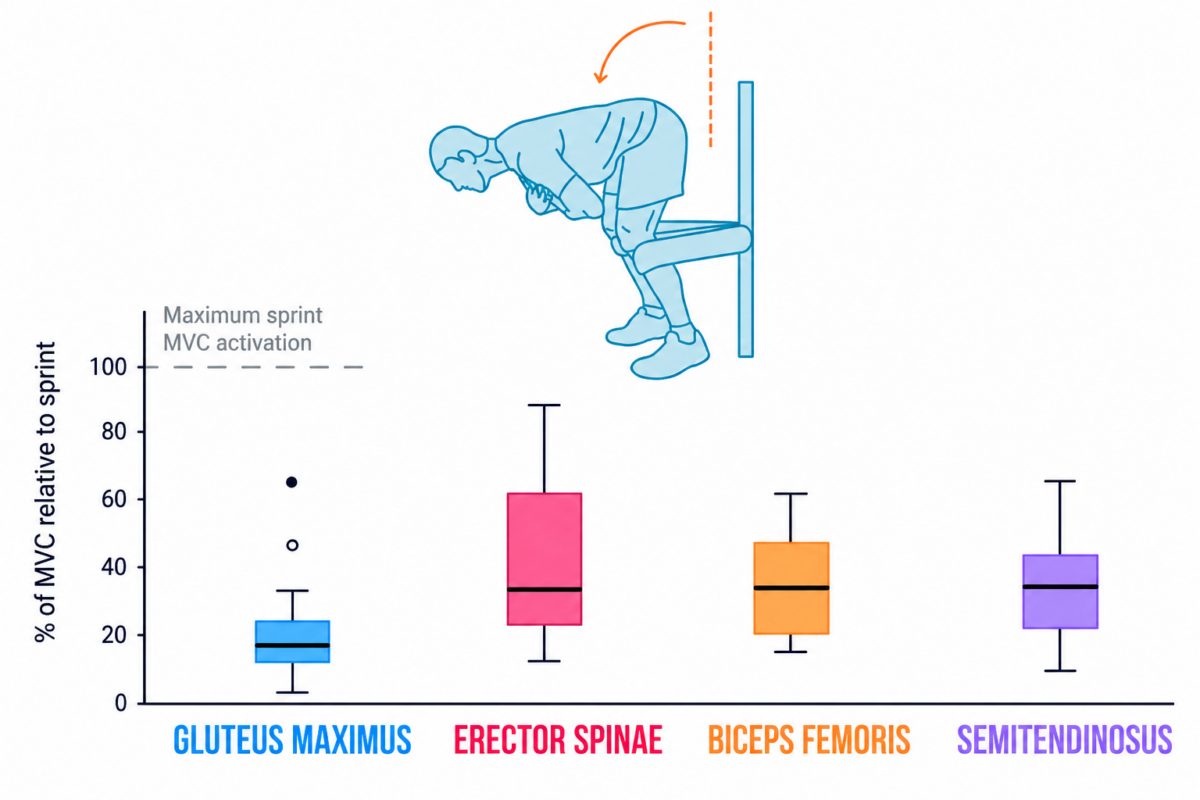
The Russian belt shows moderate hamstring activation, below 40% of the activation reached during sprinting. The gluteus maximus also has low involvement.
Activation levels are insufficient to replicate the demand of sprinting, which positions it as a low-threshold exercise suitable for early phases where load must be controlled.
Exercise 3: Glider
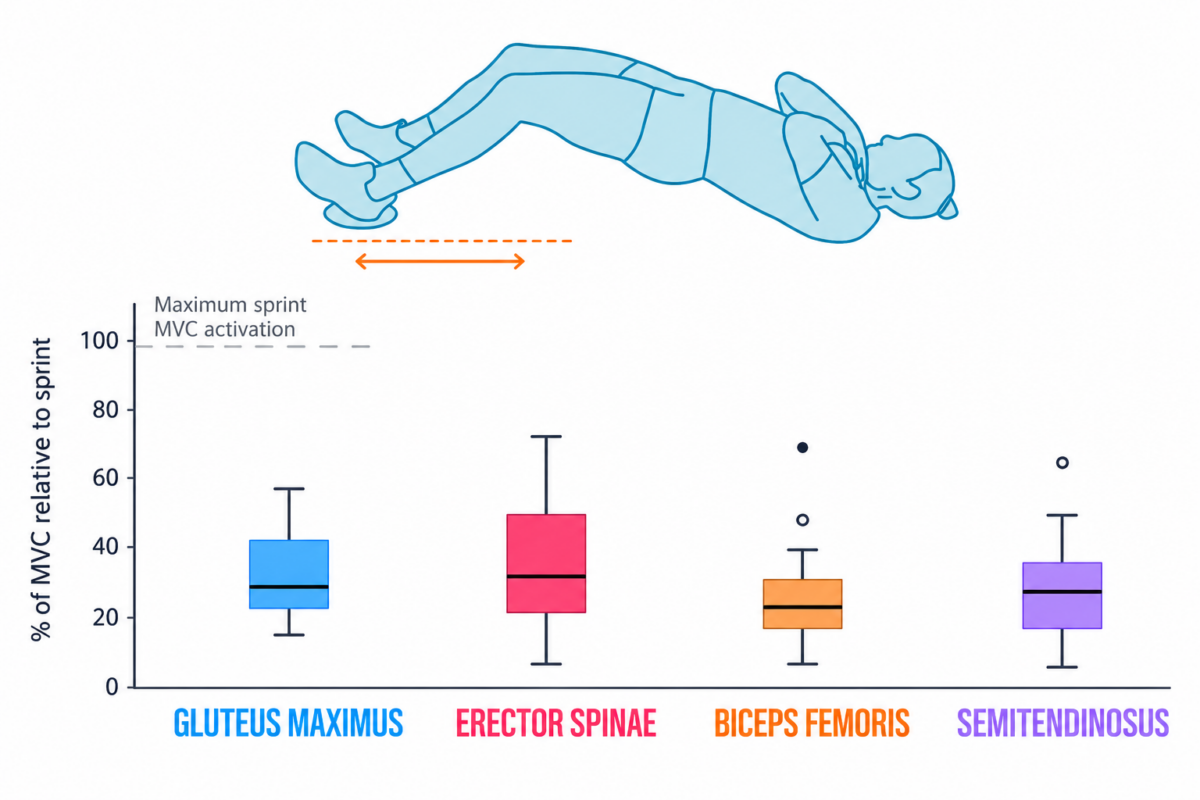
The glider shows low activation levels across all assessed muscles, below 35% of the activity recorded during sprinting. It is not a high neuromuscular demand exercise for the posterior chain.
Its value lies not in the magnitude of activation but in the movement control it requires, making it useful in the very early stages of the process.
Exercise 4: Lying kick
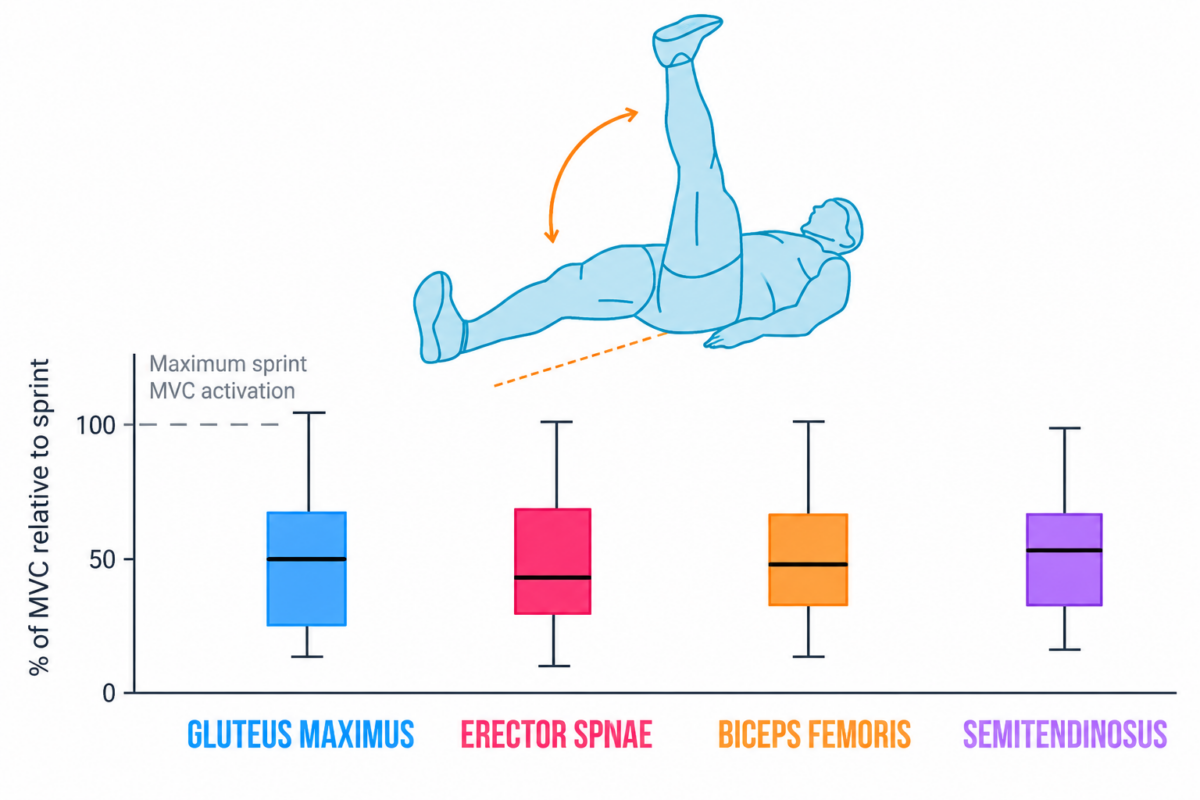
The lying kick is the exercise that most closely approaches the sprint pattern of all those assessed. It generates high activation of the gluteus maximus, the hamstrings and the spinal erector simultaneously. It is explosive, unilateral and better replicates the muscle synergy that sprinting demands.
The combination of high gluteus maximus activation with high hamstring activation is exactly what differentiates this exercise from the rest of the ranking. That synergy is what you need to train in the advanced phases of return-to-sport rehabilitation so that the athlete returns to sprinting with the muscular pattern prepared for the real demand.
How the return-to-sport programme progresses with this data
The four exercises do not compete with each other. They complement each other in a progression based on real muscular demand:
Early phase: glider and Russian belt to introduce posterior chain work with low load and movement control.
Intermediate phase: Nordic curl to develop eccentric hamstring strength, which is the most well-documented protective factor against injury.
Advanced phase: lying kick to integrate the gluteus maximus-hamstring–spinal erector synergy in a pattern that approaches the real demand of sprinting.
Without EMG, this progression is an estimate. With EMG, you can verify at each phase that the muscles are reaching the activation levels that phase requires before advancing to the next.
What EMG allows you to do that observation cannot
Knowing what each exercise activates with EMG data gives you three capabilities that directly change the quality of the programme:
Personalise rehabilitation by phase. You do not advance to the next exercise when the patient “seems” ready. You advance when the data confirm that the activation of the previous pattern is adequate.
Prevent one muscle from compensating for another. If the spinal erector is dominating where the gluteus maximus should be leading, or if the biceps femoris is working without semitendinosus involvement, EMG shows you this in real time so you can correct it before that pattern becomes established.
Design programmes closer to the reality of sprinting. Knowing that the lying kick is the exercise that most closely approaches the sprint synergy allows you to introduce it at the right moment in the process and verify with data that the athlete is generating the activation pattern they need to perform without risk.
Frequently asked questions
Is the Nordic curl alone not enough to prevent hamstring reinjury? The data suggest not, when used in isolation. The Nordic curl is highly effective for eccentric hamstring strength, but its low gluteus maximus activation limits its usefulness for replicating the sprint synergy. Reinjury prevention requires a programme that includes high-demand exercises for the gluteus–hamstring synergy, such as the lying kick, in the advanced phases.
How do I know when my patient is ready for the lying kick? The progression should be guided by activation data from the previous exercises. If the patient reaches adequate activation levels in the Nordic curl without spinal erector compensations or asymmetries between the biceps femoris and semitendinosus, it is a signal that the neuromuscular system is prepared for the greater demand of the lying kick. EMG gives you that confirmation objectively.
Why is the gluteus maximus so important in hamstring injury? During sprinting, the gluteus maximus and the hamstrings work in synergy to control hip extension and decelerate the lower limb before contact. When the gluteus maximus does not contribute sufficiently, the hamstrings take on more load than they can handle, especially in the late swing phase where the risk of injury is greatest.
Are these data applicable to athletes of all levels? The activation pattern during sprinting varies with athletic level, speed and running technique. However, the principle that rehabilitation exercises should progressively approach the muscular synergy of sprinting applies to any athlete who needs to return to that activity. EMG allows the progression criteria to be adapted to the individual characteristics of each patient.
Conclusion
Reinjury in hamstring injuries has a common and underaddressed cause: returning the athlete to sprinting without having retrained the muscular synergy that movement demands. A programme focused only on the hamstrings, without integrating the gluteus maximus or progressively approaching the real activation of sprinting, leaves the muscle prepared for the rehabilitation exercise but not for the sport.
The EMG data are clear: the lying kick is the exercise that most closely approaches the sprint synergy. The Nordic curl is the most effective for eccentric hamstring strength. The glider and the Russian belt have their place in the early phases. None replaces the others.
The question is not which exercise to use. It is which one to use at each phase, and whether it is generating the activation you need for the next phase to be safe.