Do you have patients with low back pain that worsens when they walk? The problem probably lies in how their muscles activate during gait.
Gait is not just a low-impact exercise. It is a diagnostic window. And when you measure with EMG what happens in the paraspinal muscles during that movement, the data can help you better understand why your patient’s back hurts.
In this article you will discover what differences in muscle activation exist between patients with chronic low back pain and healthy individuals during gait, why hyperactivation is not always good news and how you can use gait as a diagnostic test for lumbar compensation in your practice.
What happens in the lumbar muscles while your patient walks
A study compared the activation of the multifidus (MF) and the spinal erectors (SE) during gait in two groups: patients with chronic low back pain and healthy individuals. The results were clear.
The activation values found were as follows:
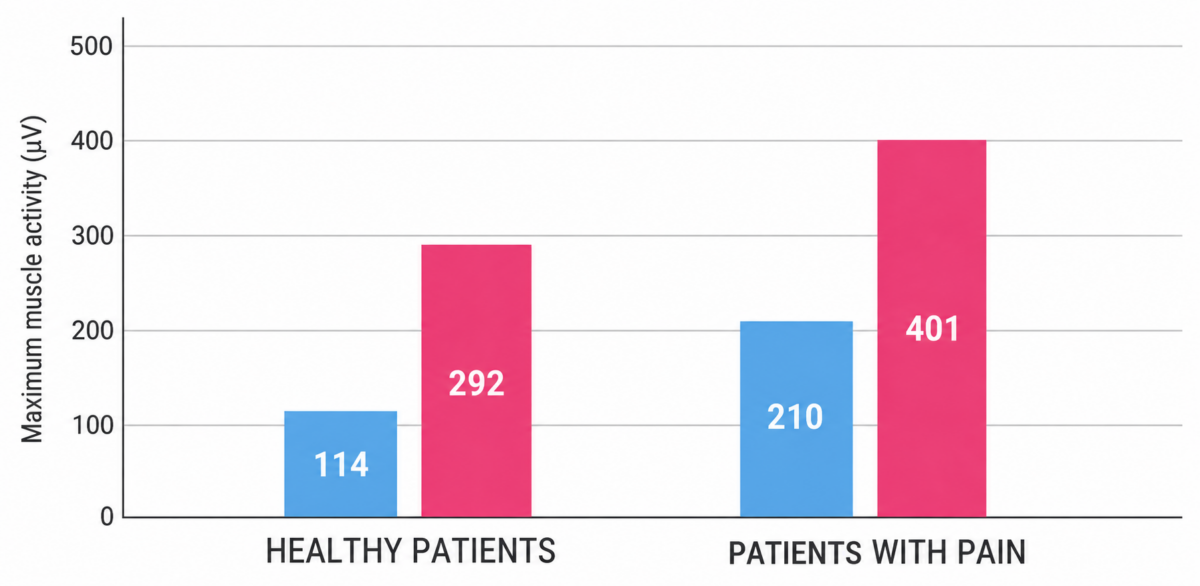
In patients with low back pain, both muscles activate approximately twice as much as in healthy subjects during the same task: walking.
Is more activation better?
At first glance it might seem so. More muscle activation implies more spinal protection, right?
Not exactly. That hyperactivation is not a sign of greater muscle efficiency. It is a sign of compensation for instability. The body needs to activate more to protect itself because segmental control is compromised.
In the short term, that defensive strategy may work. In the long term, maintaining those elevated activation levels with every step of every day generates muscle fatigue, increases the load on the passive structures of the spine and perpetuates the pain cycle. The system protects itself in a way that, paradoxically, maintains the problem.
The key difference between a healthy pattern and a compensatory pattern
In healthy individuals, the multifidus activates proportionally and efficiently during gait. It does exactly the work it is meant to do, no more, no less, and does so in a coordinated manner with the spinal erector.
In patients with low back pain, the multifidus fires well above what is necessary, as a defensive strategy the nervous system has learned to use to compensate for perceived instability.
The result is a pattern of excessive coactivation that does not improve simply by walking more: it improves when it is identified and retrained.
Gait as a diagnostic test for lumbar compensation
With EMG you can turn gait into a first-rate diagnostic tool. The patterns you can detect and their clinical interpretation are as follows:
Are the multifidus activating symmetrically and without excess? This is a good prognostic indicator. Lumbar segmental control is functioning efficiently.
Is one side firing significantly more than the other? Possible local dysfunction at that segment. A persistent asymmetry between the right and left multifidus during gait is a finding that guides both diagnosis and intervention.
Is the spinal erector clearly dominating over the multifidus? Possible loss of deep spinal control, with the superficial muscles compensating for the stabilising function that the multifidus should be performing. This is the most common pattern in chronic low back pain and the most difficult to detect without EMG.
How to use EMG to retrain the pattern
Once you have the gait data, EMG allows you to go beyond diagnosis. With real-time biofeedback you can:
Confirm whether lumbar compensations are present before prescribing any exercise, knowing exactly which muscle is overactivated and which is inhibited.
Measure paraspinal muscle activation levels under different conditions: gait speed, step length, use of a walking stick or different footwear. Each variable modifies the pattern and EMG shows you this within seconds.
Retrain the pattern with biofeedback. The patient can see in real time whether their multifidus is working efficiently or whether the spinal erector is compensating. That visual feedback accelerates motor learning in a way that no verbal instruction can match.
And all of this without invasive tests, in minutes, within your regular session.
Frequently asked questions
Does multifidus hyperactivation disappear when the pain subsides? Not necessarily. As with other neuromuscular alterations associated with chronic low back pain, the compensatory pattern can persist even when pain has decreased. Without active retraining of the motor pattern, the hyperactivation may continue and increase the risk of recurrence.
Can this assessment be performed with any type of gait? Flat-ground walking at a comfortable speed is the most informative starting point because it minimises external variables. Once you have that reference data, you can compare it with walking on a ramp, at higher speed or with load to see how the pattern evolves under different demands.
How many sensors do I need for this assessment? With two sensors you can measure the multifidus and the spinal erectors simultaneously, which are the two primary muscles in this analysis. If you want to add the gluteus maximus or the abdominal muscles to get a more complete picture of the lumbopelvic pattern during gait, you will need additional channels.
Does this hyperactivation pattern also appear in patients with acute low back pain? The study focused on patients with chronic low back pain. In acute phases, the muscular response is different and may include both hyperactivation and inhibition depending on the injury mechanism and the stage of the process. EMG assessment is equally useful in both contexts, although the findings and clinical conclusions differ.
Conclusion
Recommending that your patient walks every day is good practice. But if you do not know how their lumbar muscles are activating while they walk, you do not know whether that exercise is improving their motor pattern or simply adding kilometres on top of a compensation that no one has identified.
The data are clear: patients with chronic low back pain activate their multifidus and spinal erector twice as much as healthy individuals during gait. That is not strength. It is compensation. And compensating more is not recovering.
Gait measured with EMG gives you in minutes the information you need to know whether the pattern is improving or whether you need to intervene before continuing to add load.