Are you prescribing shoulder press to your patients without knowing which grip is generating the most scapular compensation?
The most frequent error in this exercise is not in the load or the range of motion. It lies in a muscular imbalance that occurs within the movement and is completely invisible to the naked eye: the upper trapezius dominating the serratus anterior.
When that happens, the scapula does not rotate as it should. And if it does not rotate correctly, the scapulohumeral rhythm is altered, the subacromial space is reduced and the risk of injury increases with every repetition.
In this article you will discover how grip width in the shoulder press modifies the relationship between the upper trapezius and the serratus anterior, what EMG data shows for wide, medium and narrow grips, and which clinical conclusions you can apply in your sessions starting today.
Why the trapezius-serratus synergy helps define shoulder health
Scapulohumeral rhythm depends on two muscles working in balance: the upper trapezius elevates the scapula and the serratus anterior rotates it upwards. When that balance breaks down, the mechanics of the entire shoulder complex are compromised.
An overactive upper trapezius elevates and locks the scapula instead of coordinating its rotation. A weak or inhibited serratus anterior cannot generate the upward rotation needed for the humerus to rise without compromising the subacromial space. The result is an altered scapulohumeral rhythm that, sustained over time, becomes a real injury risk factor.
The problem is that this imbalance is not visible during the exercise. The patient lifts the weight, the movement looks correct and you have no way of knowing whether the trapezius is taking on more work than it should. Unless you measure it.
Why grip width matters more than it seems
Each grip width in the shoulder press generates a different muscular demand. In some cases, the upper trapezius takes on too much work. In others, the serratus anterior activates better. And the difference between one grip and another can be the difference between an exercise that improves scapular mechanics and one that perpetuates them.
To quantify these differences, we measured with EMG the activation of the upper trapezius and the serratus anterior across three grips: wide, medium and narrow. The results show clinically relevant differences between conditions.
EMG data by grip type
Wide grip
The wide grip generates the highest upper trapezius activation of the three grips assessed and the lowest serratus anterior activation. The difference between both muscles is 207 µV, indicating a clear trapezius dominance over the serratus in this condition.
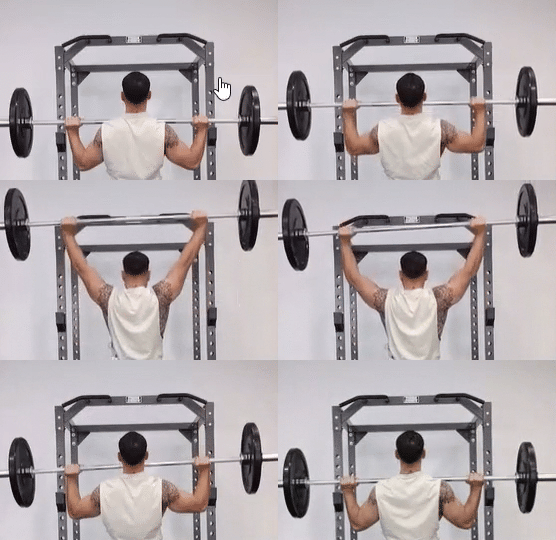
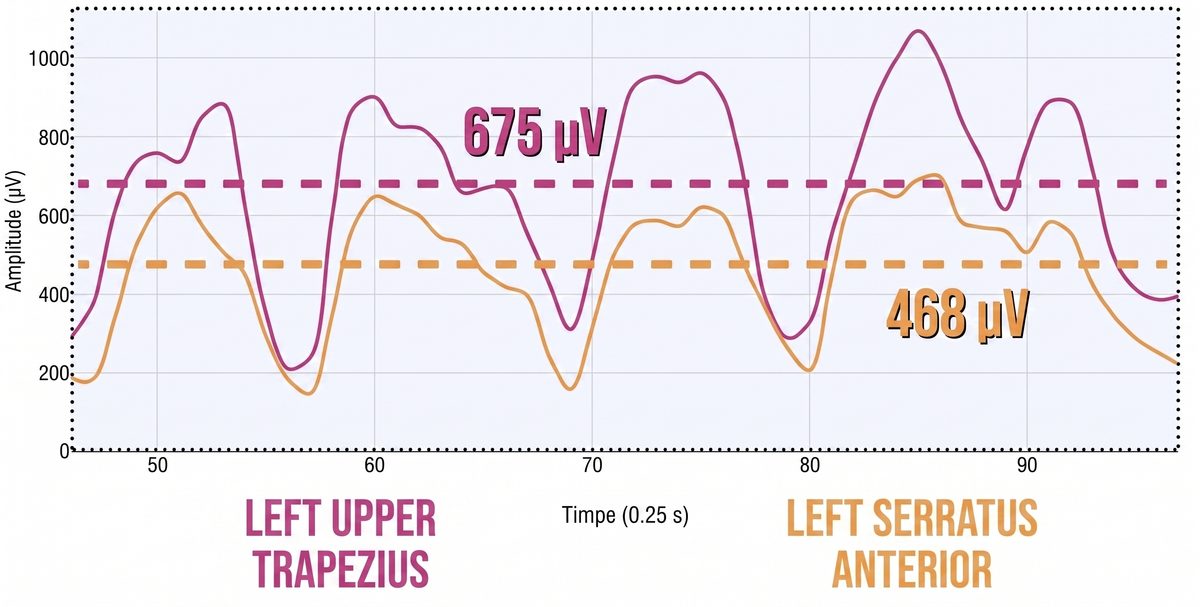
In practice, this means that with a wide grip the patient is training with a higher probability of scapular blocking and less active upward rotation. If there is already a tendency towards upper trapezius dominance, the wide grip reinforces it.
Medium grip
The medium grip improves the relationship between both muscles compared to the wide grip: the trapezius drops 37 µV and the serratus rises 30 µV. The difference between the two is reduced to 140 µV. This is an improvement, but trapezius dominance over the serratus remains evident.
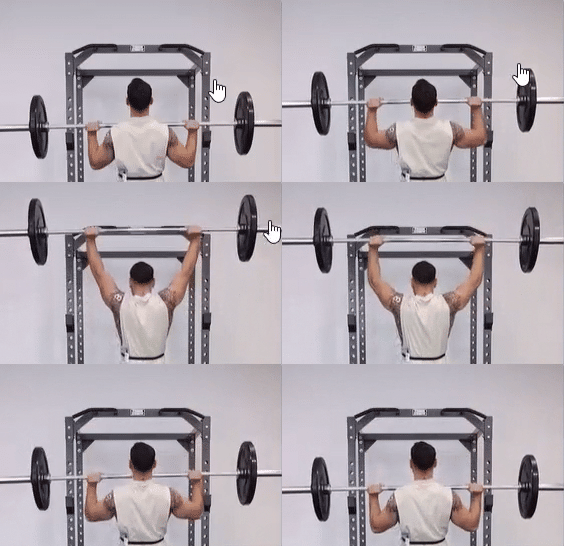
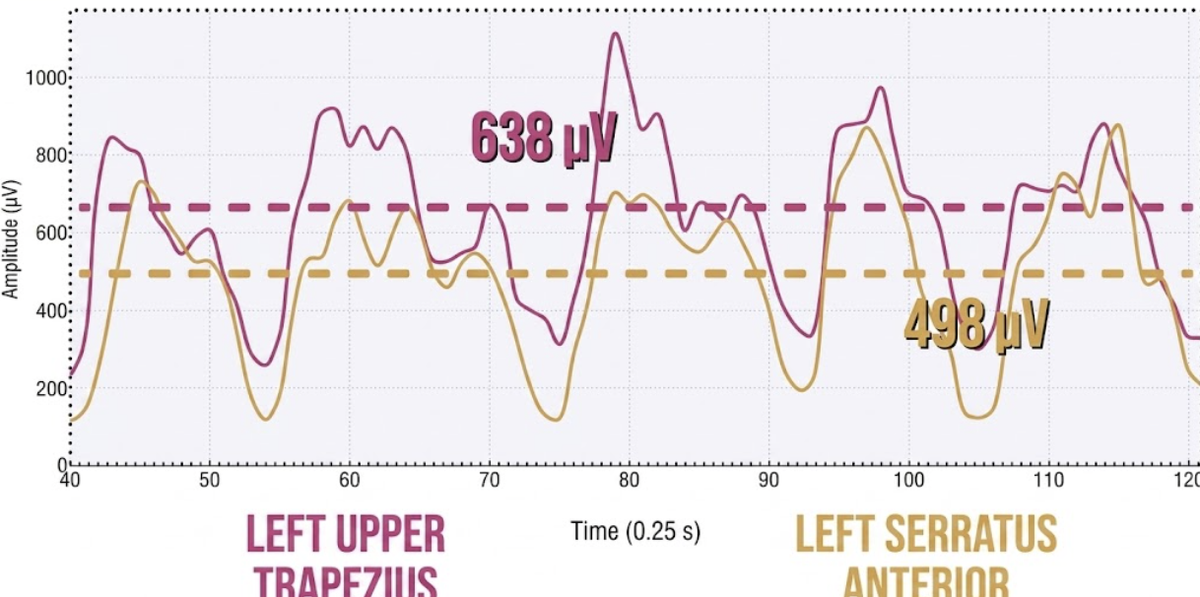
If the medium grip is the one you routinely use with your patients, you are in a better position than with the wide grip, but still far from the balance that protects scapular mechanics.
Narrow grip
The narrow grip is the only one of the three that achieves balanced activation between both muscles: 650 µV in the upper trapezius and 650 µV in the serratus anterior. A 1:1 ratio indicating that neither muscle dominates the other during the movement.
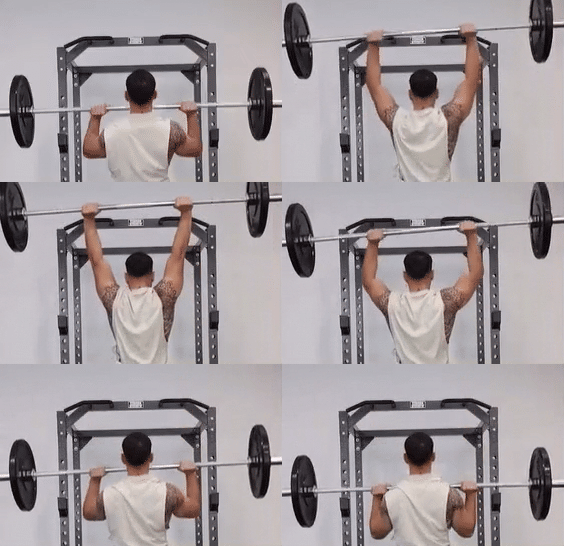
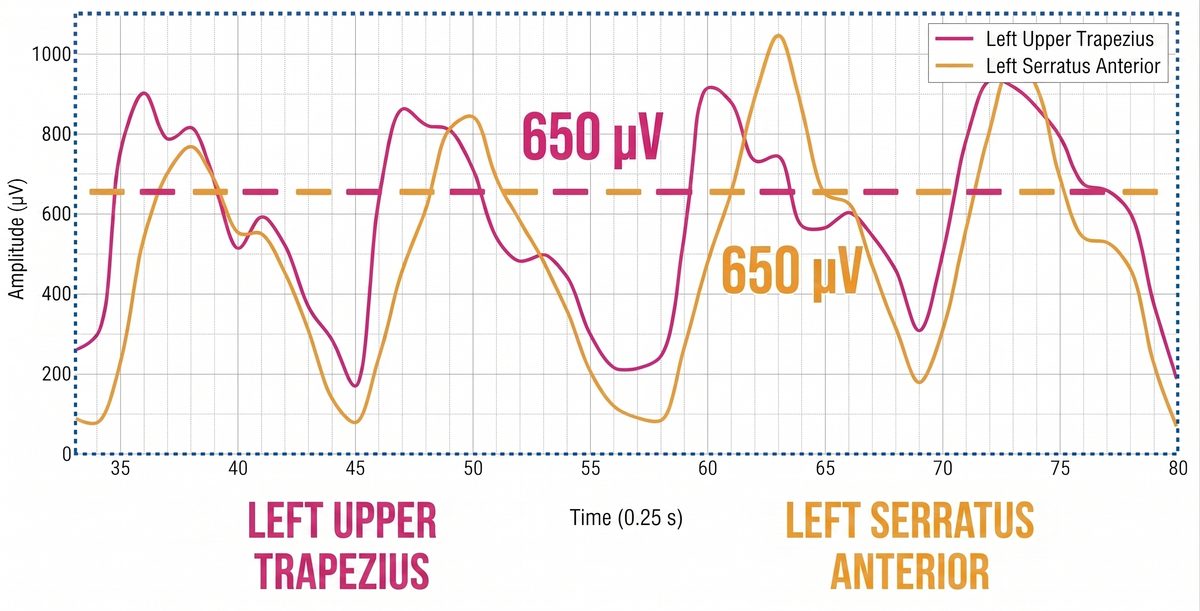
From a clinical standpoint, this is the grip that best promotes scapular synergy in the shoulder press. The serratus can generate the upward rotation it is responsible for without the trapezius blocking it.
What this means if you are not measuring it
If you are not measuring muscle activation during the shoulder press, you may be prescribing weeks of training with a grip that is reinforcing exactly the compensatory pattern you want to correct. The patient works, the movement looks correct, the load progresses — but the trapezius–serratus synergy remains imbalanced.
Worse still: if you increase the load without correcting that imbalance, you are adding more stress to an already altered mechanical pattern. The risk of injury does not decrease with training. It increases.
EMG allows you to detect that imbalance before it generates symptoms and adjust the grip based on data, not intuition.
Clinical conclusions
If you want your patient to activate the serratus anterior more, use a narrow grip. It is the only one of the three grips that manages to balance the trapezius–serratus synergy in the shoulder press.
If you see that the upper trapezius is dominating, review the grip before increasing the load. Progressing in weight with an active trapezius dominance pattern does not improve scapular mechanics. It worsens them.
The balance between the upper trapezius and serratus anterior is the key to preventing pain and improving shoulder stability. It is not a secondary variable. It is the variable that determines whether the exercise is protecting the shoulder or putting it at risk.
Frequently asked questions
Is the narrow grip in the shoulder press safe for all patients? Generally yes, but like any technical variation, it must be adapted to the patient. In people with limited internal rotation mobility in the shoulder or with acromioclavicular pathology, the narrow grip may not be well tolerated. Prior EMG assessment allows you to identify the most appropriate grip for each patient before prescribing it.
Do these data apply to the dumbbell press as well, or only the barbell? The data from this study were obtained under a specific press condition. The principle that grip width modifies the trapezius–serratus synergy is transferable to other variations, but the exact values may differ. If you routinely work with dumbbells or other implements, EMG measurement under that specific condition will give you the most relevant data for your practice.
How do I know if my patient has upper trapezius dominance without EMG? You can observe whether the scapula elevates excessively during the press, whether there is neck shortening during the movement or whether the patient reports cervical tension after the exercise. However, these signs are delayed and imprecise: they appear when the imbalance has already been established for some time. EMG detects the problem before it generates visible symptoms.
Does it make sense to vary the grip between sets to work both muscles? It is a valid strategy if the goal is to work both the serratus and the upper trapezius with different demands. However, if a clear dysfunction exists, the most appropriate approach is to prioritise the grip that corrects the imbalance until the synergy normalises, and then progress to other grips once EMG confirms that the motor pattern has improved.
Conclusion
Grip width in the shoulder press is not a minor technical detail. It is a variable that directly modifies the synergy between the upper trapezius and the serratus anterior and, with it, the scapular mechanics of the entire movement.
The EMG data are clear: the wide grip promotes upper trapezius dominance, the medium grip improves the relationship but does not balance it, and the narrow grip is the only one that allows both muscles to work at the same level.
If you are not measuring this variable, you are prescribing shoulder press without knowing whether you are correcting the problem or reinforcing it.