Real muscle activation data
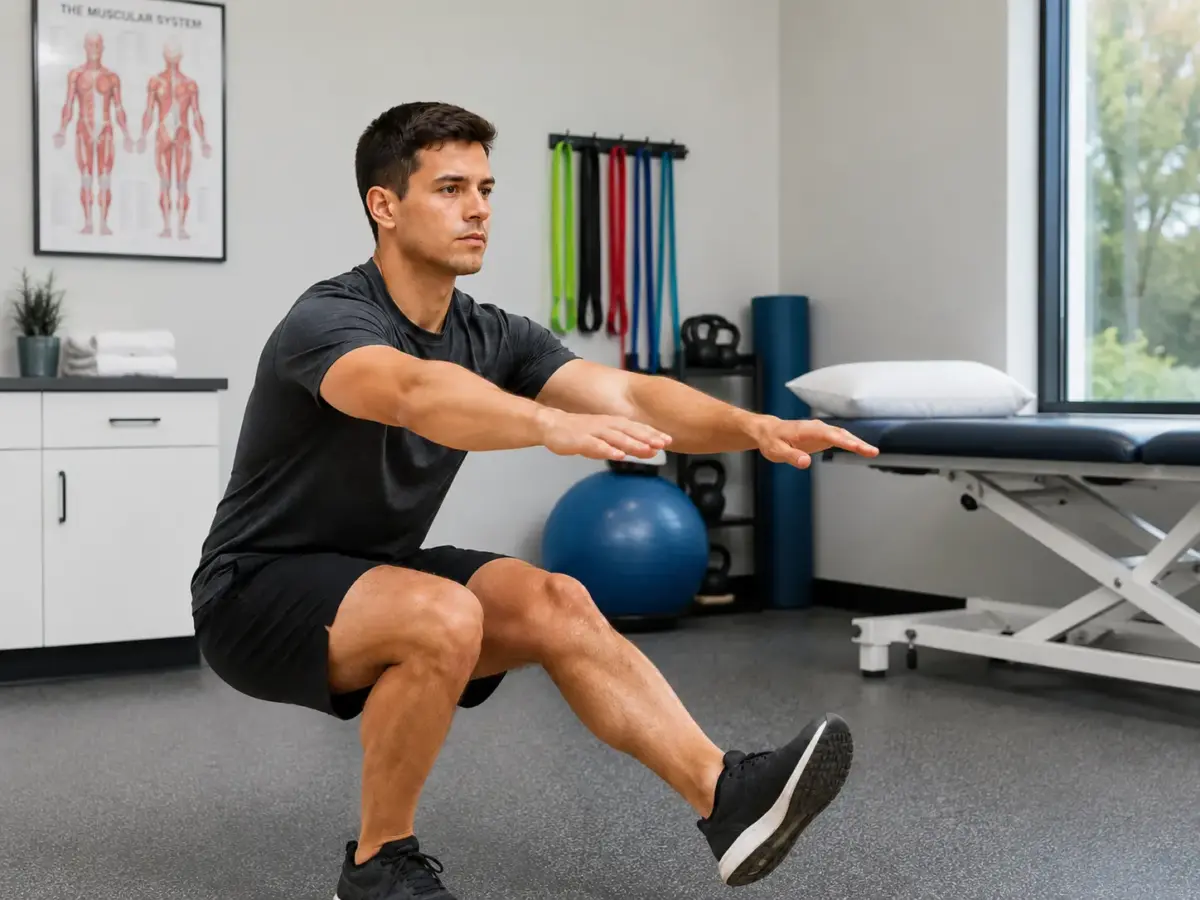
Do you use the single-leg squat to work the gluteus maximus of your patients? If so, the data from this study is going to make you reconsider the purpose of that exercise.
A study with 40 participants measured real muscle activation during the single-leg squat using surface electromyography, expressing the results as a percentage of maximum voluntary contraction (%MVC).
The results make it clear that the single-leg squat is not what many people think it is.
The most active muscles in the single-leg squat
1. Vastus lateralis: 69% MVC
The vastus lateralis is the most active muscle during the single-leg squat with 69% MVC.
This makes the single-leg squat a particularly effective exercise for the lateral quadriceps, with direct applications in knee rehabilitation, patellofemoral syndrome and lower limb strengthening in athletes.
2. Vastus medialis: 66.6% MVC
The vastus medialis reaches 66.6% MVC, almost on a par with the vastus lateralis. This bilateral quadriceps activation confirms that the single-leg squat places high demand on the knee extensor mechanism.
In patients with a vastus medialis–lateralis imbalance, EMG allows you to verify whether that imbalance persists during execution and adjust technique accordingly.
3. Gluteus medius: 37.1% MVC
The gluteus medius is the third most active muscle, at 37.1% MVC. Its role in this exercise makes sense: the single-leg squat demands pelvic stabilisation in the frontal plane, and the gluteus medius is the primary muscle responsible for that control.
If it fails, the pelvis drops towards the side of the suspended leg, increasing knee valgus and the risk of injury.
The least active muscles
Gluteus maximus: 19.5% MVC
This is probably the most clinically relevant finding in the study. The gluteus maximus only reaches 19.5% MVC during the single-leg squat. The gluteus maximus is not the primary muscle in this exercise.
If your therapeutic goal is to strengthen the gluteus maximus, the single-leg squat is not the best tool. Other exercises such as the hip thrust or hip extension variations generate considerably higher levels of gluteus maximus activation.
Medial gastrocnemius: 20.4% MVC
The medial gastrocnemius shows moderate activation at 20.4% MVC. It contributes to ankle stabilisation and descent control, but is not a primary muscle in this exercise.
Adductors: 13.3% MVC
The adductors are the least active muscle group of all those assessed, at only 13.3% MVC. If your goal is to work the adductors, the single-leg squat is not the right exercise.
Data to apply in your clinical practice
The knee carries the greatest workload
With the vastus lateralis and vastus medialis both above 65% MVC, the single-leg squat is fundamentally a quadriceps exercise. This makes it a very useful tool for knee rehabilitation, but also means it may not be the most appropriate exercise in the early stages of recovery from an extensor mechanism injury.
The gluteus maximus needs other exercises
19.5% MVC is not sufficient to generate significant strength adaptations in the gluteus maximus. If that muscle is your target, you need to prescribe exercises where the hip works in extension with a greater range and load. The hip thrust, single-leg Romanian deadlift and four-point kneeling hip extensions are options with considerably higher levels of gluteus maximus activation.
The gluteus medius is the key to stability
The 37.1% MVC of the gluteus medius is not the highest value in the ranking, but it is the most relevant in terms of motor control. A gluteus medius that fails during the single-leg squat generates knee valgus, pelvic drop and overload of the iliotibial band. EMG allows you to detect that deficit before it generates symptoms.
How to use EMG to optimise single-leg squat prescription
Knowing the average activation values from a study is useful, but what really matters is knowing what is happening in your specific patient. Muscle activation varies depending on technique, fatigue level, recovery phase and each individual’s characteristics.
With EMG you can:
Verify whether the vastus medialis and vastus lateralis are working in a balanced way. An imbalance between the two during the single-leg squat is a clinical finding directly applicable to patellofemoral rehabilitation.
Check whether the gluteus medius is stabilising the pelvis. If its activation is low, the problem is probably not isolated gluteus medius strength, but its response capacity under single-leg loading conditions.
Confirm that the exercise is not generating excessive demand for the patient’s current recovery phase. 69% MVC in the vastus lateralis may be exactly what you need (or it may be too much) depending on tissue status and phase of treatment.
Frequently asked questions
Is the single-leg squat a good exercise for knee rehabilitation? It depends on the goal and the phase. With the vastus lateralis and vastus medialis above 65% MVC, it generates high demand on the extensor mechanism. It is a very useful exercise in advanced rehabilitation phases, but may be excessive in early stages. EMG allows you to verify whether the load is appropriate for the current point in the process.
Why does the gluteus maximus activate so little in the single-leg squat? Because the range of hip motion in this exercise is limited compared to other posterior chain exercises. The gluteus maximus works primarily in hip extension with a wide range. In the single-leg squat, the main demand falls on controlling knee flexion and stabilising the pelvis, not on powerful hip extension.
Are these data applicable to all patients? The study values represent an average across 40 participants. Real activation varies depending on execution technique, squat depth, speed and the individual characteristics of each patient. This is why individual EMG measurement is always more informative than population reference values.
Which exercise activates the gluteus maximus more if the single-leg squat is not sufficient? The hip thrust is consistently the exercise with the greatest gluteus maximus activation in the literature. Prone hip extension, the Romanian deadlift and Bulgarian split squat variations also generate activation levels considerably higher than the 19.5% MVC recorded in the single-leg squat.
Conclusion
The single-leg squat is a quadriceps exercise with an important gluteus medius stabilisation component. It is not a gluteus maximus exercise. The data confirm it: 69% MVC in the vastus lateralis, 37.1% in the gluteus medius and only 19.5% in the gluteus maximus.
Knowing these values allows you to prescribe with precision: use the single-leg squat when the goal is the quadriceps or pelvic stabilisation, and choose other exercises when the gluteus maximus is the muscle you need to target.
Without EMG, this distinction is difficult to make for each individual patient. With EMG, you have it in real time.