Are you still using the same exercise to work the serratus anterior of your patients without knowing whether it is really recruiting it?
This is one of the most frequent errors in shoulder rehabilitation, and it has direct consequences on the speed of your patients’ recovery.
The three most common mistakes when working the serratus are easy to make and difficult to detect without objective tools: always using the same exercise without checking whether it generates sufficient activation, never measuring that activation at any point in the process and choosing loads or variations at random rather than based on data. The result is a protocol that may be operating well below its potential for weeks without you knowing.
In this article you will discover which five exercises generate the greatest serratus anterior activation according to surface EMG data, what values express those differences and how to use that information to improve your protocols and accelerate your patients’ results.
Why the serratus anterior is so difficult to train effectively
The serratus anterior is the primary muscle responsible for scapular protraction and upward rotation, functions essential for any arm elevation movement. When it fails, the scapula loses its optimal position, the supraspinatus works under worse mechanical conditions and the risk of subacromial impingement and rotator cuff injuries increases considerably.
The problem is that the serratus is a deep muscle, with an anatomy that makes both palpation and direct observation of its activation difficult. You can see if the scapula is winging or if there is dyskinesis, but you cannot know with certainty what level of activation the serratus is generating during a given exercise.
Without that information, exercise prescription for the serratus is largely an estimate. And estimates, in rehabilitation, have a direct cost in recovery time.
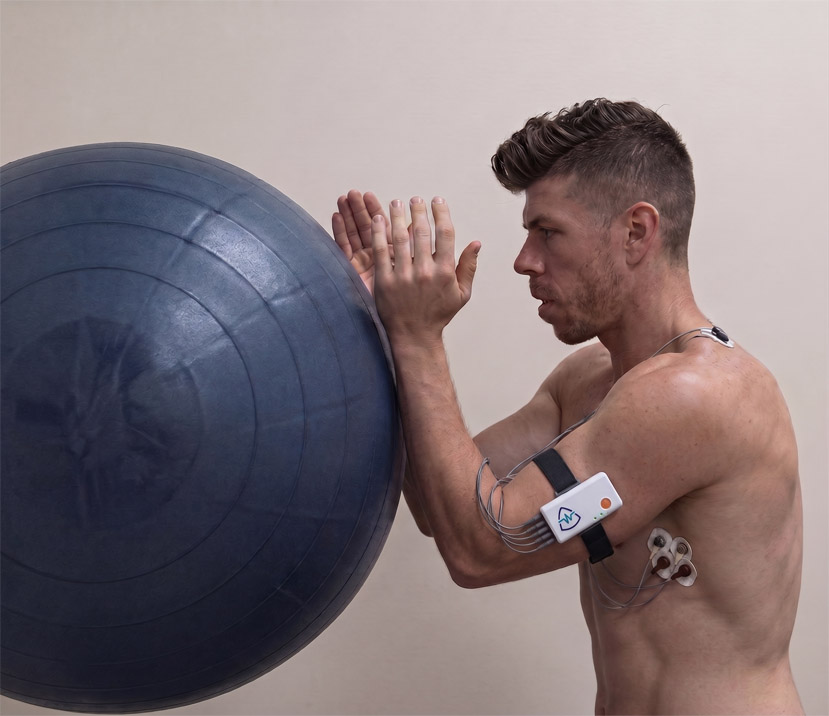
Why do all the ranked exercises use a Swiss ball?
It is not a coincidence. The Swiss ball was chosen as a common element in the study design precisely to isolate the effect of instability and variation in support on serratus activation, while keeping the type of equipment constant between exercises.
This allows the results to be compared between variations with greater rigour, because the activation difference you see in the ranking reflects the impact of the gesture and position, not a change in equipment.
The push-up without a Swiss ball serves as a reference so you can see exactly how much instability adds to the serratus demand in each variation.
A note on units of measurement
The values in this ranking are expressed in microvolts (µV), which is the unit surface EMG uses to record raw electrical muscle activity. Unlike rankings expressed in %MVC (Maximum Voluntary Contraction), these values reflect the EMG signal amplitude without normalisation, making them especially useful for comparing the relative response between exercises under similar assessment conditions.
What matters is not the absolute value of each exercise, but the difference between them: the one-handed wall slide with a Swiss ball generates almost double the activation of the push-up used as reference.
Serratus anterior activation ranking by exercise
🥇 1. One-handed wall slide with Swiss ball: 550 µV
The unilateral wall slide with a Swiss ball is the exercise that generates the greatest serratus anterior activation. The combination of the unstable Swiss ball surface with unilateral support increases the demand for active scapular protraction and forces the serratus to work throughout its full range, from the starting position to the end of the slide.
The instability of the Swiss ball is the differentiating factor: the serratus not only has to generate force but must also maintain scapular control on a constantly changing surface. This elevates neuromuscular recruitment above any variation performed on a stable surface.
🥈 2. Wall slide with Swiss ball (bilateral): 500 µV
The bilateral version of the wall slide with a Swiss ball reaches 500 µV, just 50 µV below the unilateral variation. It remains a high-demand exercise for the serratus and an excellent option when the patient cannot yet tolerate unilateral work or when the goal is to address scapular symmetry between both sides.
It is also a good progression from more basic exercises: the Swiss ball adds instability without increasing the mechanical load on the shoulder, making it useful in intermediate rehabilitation phases.
🥉 3. Pushing the Swiss ball against the wall: 450 µV
The push exercise against the wall with a Swiss ball generates 450 µV in the serratus anterior. Unlike the wall slide, this exercise works scapular protraction through a shorter range but with greater isometric demand at the end of the movement, where the serratus has to hold the scapula in maximum protraction against the resistance of the ball.
It is a particularly useful option for patients who do not yet have good control of the slide or who need to develop the ability to sustain protraction before adding movement.
4. Single-arm ab rollout with Swiss ball: 375 µV
The unilateral ab rollout generates 375 µV in the serratus anterior. The position demands that the serratus keep the scapula adhered to the thoracic cage under the load of the entire body weight, and the rollout movement adds a dynamic demand that increases recruitment compared to the standard plank.
At 375 µV it falls below the Swiss ball exercises, but it remains a moderate-to-high activation option with the advantage of requiring no additional equipment and simultaneously training core stability.
5. Push-up without Swiss ball (reference): 300 µV
The standard push-up serves as the reference exercise in this ranking, with 300 µV of serratus anterior activation. It is the starting point from which the progression is built: all the higher-ranked exercises generate between 25% and 83% more activation than the basic push-up.
This does not mean the push-up is a poor exercise for the serratus, but rather that if you have been using it for weeks as the primary exercise without progressing to more demanding variations, the stimulus on the serratus is likely below what you need to generate significant adaptations.
Frequently asked questions
Why does the Swiss ball increase serratus activation so much? The unstable surface forces the neuromuscular system to increase recruitment of all scapular stabilising muscles to maintain control during movement. The serratus, as the primary stabiliser of the scapula against the thoracic cage, is the muscle that benefits most from that additional control demand.
When is the right time to introduce Swiss ball exercises in serratus rehabilitation? It depends on the phase and the patient’s tolerance. In early phases with high joint irritability, a modified push-up or wall push are safer options. Swiss ball exercises are more appropriate when the patient already has basic scapular control and can tolerate instability without compensating with the upper trapezius or cervical spine.
How do I know if my patient is compensating with the upper trapezius during these exercises? With EMG you can simultaneously monitor the serratus anterior and the upper trapezius during the exercise. If the upper trapezius is activating excessively while the serratus is not reaching the expected levels, you have confirmation of a compensation and can adjust the exercise accordingly: change the arm position, reduce the load or modify the technique.
Can I use the µV ranking to compare between patients? Not directly. Non-normalised µV values depend on individual factors such as subcutaneous tissue thickness, electrode position and each patient’s own characteristics. They are useful for comparing exercises within the same patient, but not for establishing comparisons between individuals. For inter-patient comparisons, normalised %MVC values are more appropriate.
Conclusion
The serratus anterior is one of the most important muscles in shoulder rehabilitation and one of the most difficult to train with sound criteria without objective tools. Always using the same exercise, not measuring activation and choosing variations at random are the three errors that most delay recovery in these patients.
The EMG data are clear: the Swiss ball wall slide, especially in its unilateral version, generates considerably higher levels of serratus anterior activation than the standard push-up. Incorporating that progression into the protocol, and verifying with EMG that the activation is appropriate for each patient, makes the difference between a programme that advances and one that stagnates.
Because it is not about doing more exercises. It is about doing the right ones, with the right activation, at the right point in the process.