Measured with electromyography
The middle deltoid is primarily responsible for shoulder abduction and is one of the key muscles for developing the shoulder. However, in clinical practice and training, it’s common to find patients or athletes who believe they are working it, when in reality other muscles are taking over.
The result is a very common pattern: the anterior deltoid and upper trapezius dominate the movement, while the middle deltoid remains under-stimulated.
This not only limits hypertrophy, but can also alter shoulder mechanics and promote compensations.
That’s why understanding which exercises truly activate the middle deltoid will help you design more effective training programs.
Now think about this: how many of your patients believe they are training the middle deltoid, when in reality they are relying on the trapezius or anterior deltoid?
At first glance, the exercise looks correct, but the muscle you want to develop is not receiving the necessary stimulus.
Click here, request more information, and learn how to use EMG to measure real middle deltoid activation, correct compensations, and choose the exercises that truly generate hypertrophy.
In this post, you will learn 8 exercises ranked according to their level of muscle activation measured with electromyography (EMG), along with their practical application so you can start using them today.
What muscle activation means in EMG
Surface EMG allows you to measure the electrical activity of a muscle during an exercise. This gives you information about how much a muscle is being activated relative to its maximum capacity.
It’s important to understand that higher activation does not automatically guarantee more hypertrophy, but it does indicate that the muscle is receiving a higher neuromuscular stimulus, increasing the likelihood of generating enough mechanical tension to grow.
In other words, EMG does not replace training programming, but it helps you answer a key question:
Is this exercise actually activating the muscle I want to target?
The 8 exercises with the highest middle deltoid activation (relative to Maximum Voluntary Contraction, MVC)
1. 45º bent-over row: 84% MVC
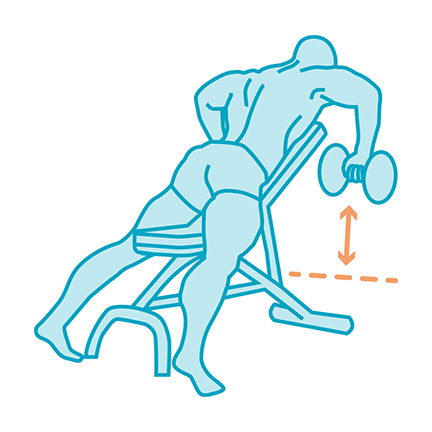
It may be surprising to see this exercise in first place, as it is traditionally associated with back training. However, when performed with the correct angle, the middle deltoid is highly involved.
The key lies in the movement path. If the motion is oriented toward abduction with slight retraction, the shoulder works in a plane where the middle deltoid plays an important role.
This exercise is especially useful when aiming for a high stimulus in more global contexts, where other muscle groups are also involved.
2. Dumbbell lateral raises: 77%
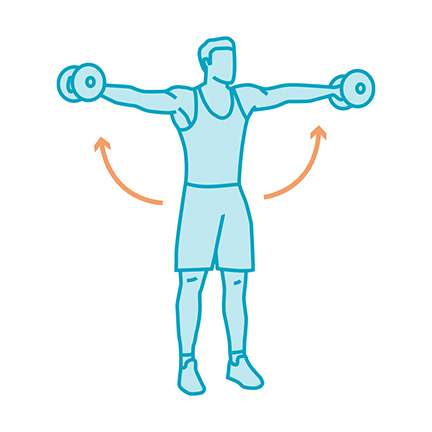
This is the classic exercise for targeting the middle deltoid, and for good reason. Its high activation makes it one of the best options for specific hypertrophy.
However, its effectiveness depends entirely on technique. When the load is too heavy or the movement is performed with momentum, the upper trapezius tends to dominate.
To maximize middle deltoid activation, it’s important to maintain a slight forward lean, raise the arms in the scapular plane, and avoid shrugging the shoulders.
3. Cable diagonal raise: 74%
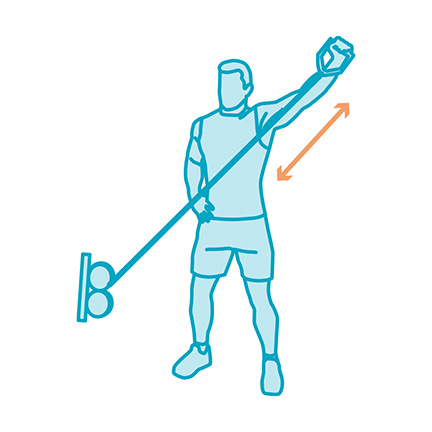
This exercise introduces a constant force vector and a more functional movement path. Cable resistance maintains tension throughout the entire range of motion, which is not always the case with dumbbells.
Additionally, the diagonal pattern promotes better coordination between the scapula and humerus, improving movement quality and muscle activation.
It is a very interesting option when aiming to combine hypertrophy with motor control.
4. Barbell upright row: 73%
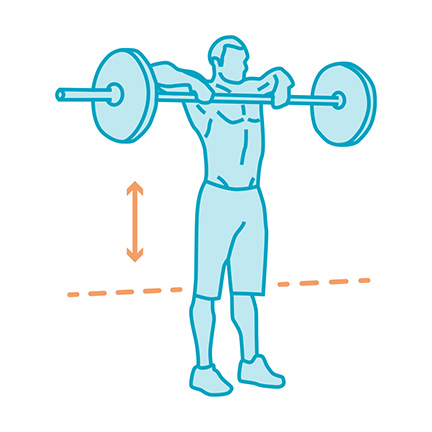
The upright row is a powerful shoulder exercise, but also one of the most commonly misperformed.
When executed with proper grip and without excessive shoulder elevation, the middle deltoid can be significantly activated. However, if technique is poor, the upper trapezius tends to dominate.
For this reason, it should be used carefully, especially in patients with a history of neck pain or cervical overload.
5. Seated reverse fly: 70%
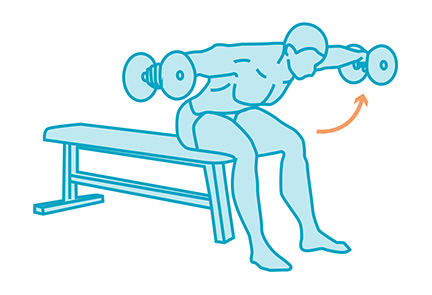
Although this exercise is mainly associated with the posterior deltoid, it also significantly involves the middle deltoid, especially when the execution angle is adjusted.
It is a good option for overall shoulder development, particularly in programs focused on improving stability and scapular control.
6. Dumbbell shoulder press: 62%
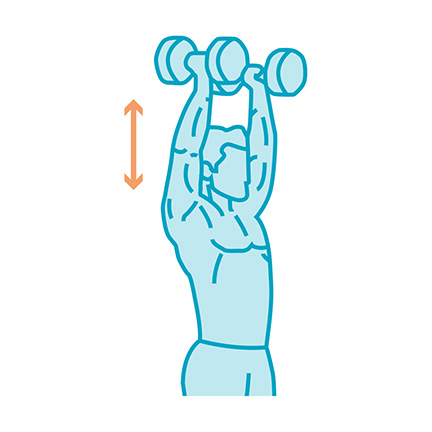
The shoulder press is a more global exercise involving several muscles, including the anterior deltoid, triceps, and trapezius.
Although the middle deltoid participates, its activation is lower compared to more specific exercises. Still, it is useful in phases aimed at developing general strength and load capacity.
7. Battling Rope: 37%
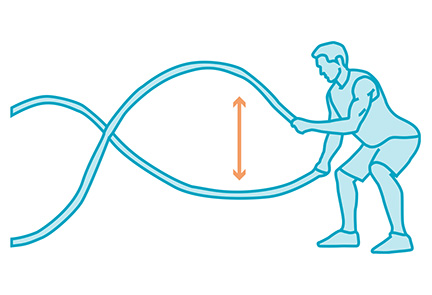
Battling Rope produces moderate activation of the middle deltoid, mainly due to its stabilizing role during repetitive movements.
It is not a specific exercise for hypertrophy, but it can be useful as a complement in conditioning or metabolic training phases.
8. Dumbbell front raise: 36%
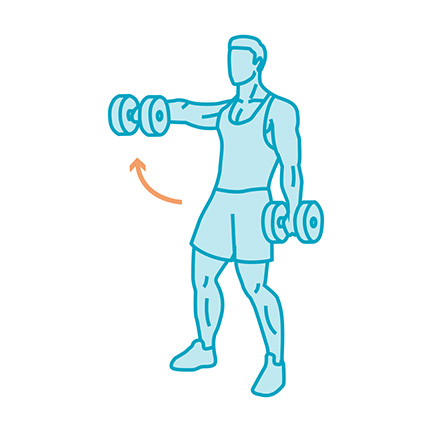
This exercise primarily targets the anterior deltoid, so middle deltoid involvement is limited.
Although it can be part of a shoulder program, it is not a good choice if the main goal is to develop the middle deltoid.
The most common mistake when training the middle deltoid
One of the most frequent mistakes is thinking that any shoulder exercise will equally stimulate all its portions.
In practice, this is not the case. Many exercises that seem appropriate end up generating more activation in the anterior deltoid or the upper trapezius.
This explains why some patients or athletes train shoulders for months without seeing improvements in shoulder width or lateral control.
The problem is not a lack of training. The problem is that the target muscle is not receiving the appropriate stimulus.
How to apply this information in clinical practice or training
Selecting the right exercises is only the first step. It is also necessary to adjust variables such as technique, load, range of motion, and fatigue.
The same exercise can activate the middle deltoid very differently depending on how it is performed.
That’s why combining EMG knowledge with clinical observation and patient feedback allows you to design much more precise interventions.
Electromyography allows you to verify something that you could otherwise only intuit: which muscle is actually working during an exercise.
This is especially useful in the shoulder, where compensations are very common.
With EMG, you can see whether the middle deltoid is truly the main contributor or if other muscles are taking over. You can also adjust technique in real time and check whether those changes improve activation.
This turns every exercise into a much more precise tool.
Conclusion
The development of the middle deltoid largely depends on choosing the right exercises and executing them correctly.
According to electromyography, the exercises with the highest activation are:
- 1. 45º bent-over row.
- 2. Lateral raises.
- 4. Cable diagonal raise.
- 4. Upright row.
However, more important than the list is understanding the principle: not all exercises activate the muscle you think they do.
And if the middle deltoid is not sufficiently activated, hypertrophy will not occur, no matter how much the patient trains.
That’s why the key is not doing more exercises, but making sure each repetition generates the correct stimulus.
Here’s an important question: how much time are your patients losing training shoulders without knowing whether they are activating the right muscle?
If you don’t measure, it’s easy to repeat exercises that are not generating real adaptation.